
A race against time – Green Skills Gap
Research conducted by EIT InnoEnergy Skills Institute over the past four years has identified more than 600 unique job profiles and skills across the battery value chain. This incredibly diverse range of occupations encompasses the skills required to design, manufacture, maintain, troubleshoot, and repair batteries for their different applications.
The research performed, and the results presented, in this report do not extend to ‘soft skills’ considerations such as teamwork, communication, project management, leadership, critical thinking, planning, and organisation. Although these personal qualities help employees thrive in the workplace and are just as essential to success as the ‘hard skills’ being flagged for attention.
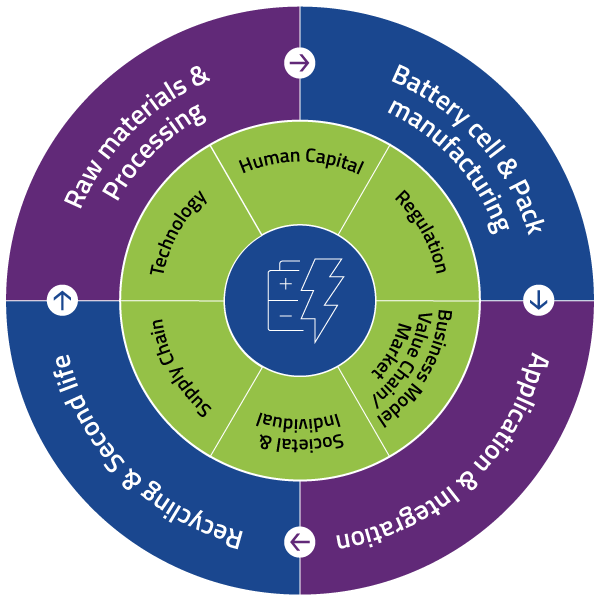
As the sector booms there is an urgent need for employers and education and training providers to adapt quickly to the changes and new requirements. For instance, the rapidly expanding demand for lithium-ion batteries gives rise to the need for additional job profiles skills across every link of the battery value chain, including:
- Raw materials and processing
- Battery cell and pack manufacturing
- Application and integration
- Recycling and second life
To meet capacity targets for 2030, the industry needs to have trained workers in place today to be able to scale and deliver. This time pressure to have access to skilled workers is the biggest challenge facing the industry right now.
Some of the skills required to meet the demand are very sector-specific and new, while others are non-sector-specific and already prevalent in other industries such as electronics, pulp and paper, chemicals, and pharmaceuticals. Digital skills such as data analysis, data science, artificial intelligence, and software engineering are going to be even more highly sought after.
The EU workforce is regarded as highly qualified, although sufficient specialised battery-related knowledge and skills are still lacking across educational segments. In short, there’s every indication that investment in specific training and upskilling programmes is essential if employers and education and training providers are to remain competitive in their respective sectors and keep up with the pace.
To learn more about what we need to do today to be ready for the Net Zero economy, download a full copy of the report Powering the Transition to Net Zero Economies at https://www.niit.com/skillsinstitute/