


Agentic AI Applied Program
Build production-ready Agentic AI systems using RAG, Conversational AI, AI Agents, and Multi-Agent Workflows to create intelligent, scalable, enterprise-grade AI applications that automate processes, enhance decision-making, and deliver real-world business value.
Program Overview
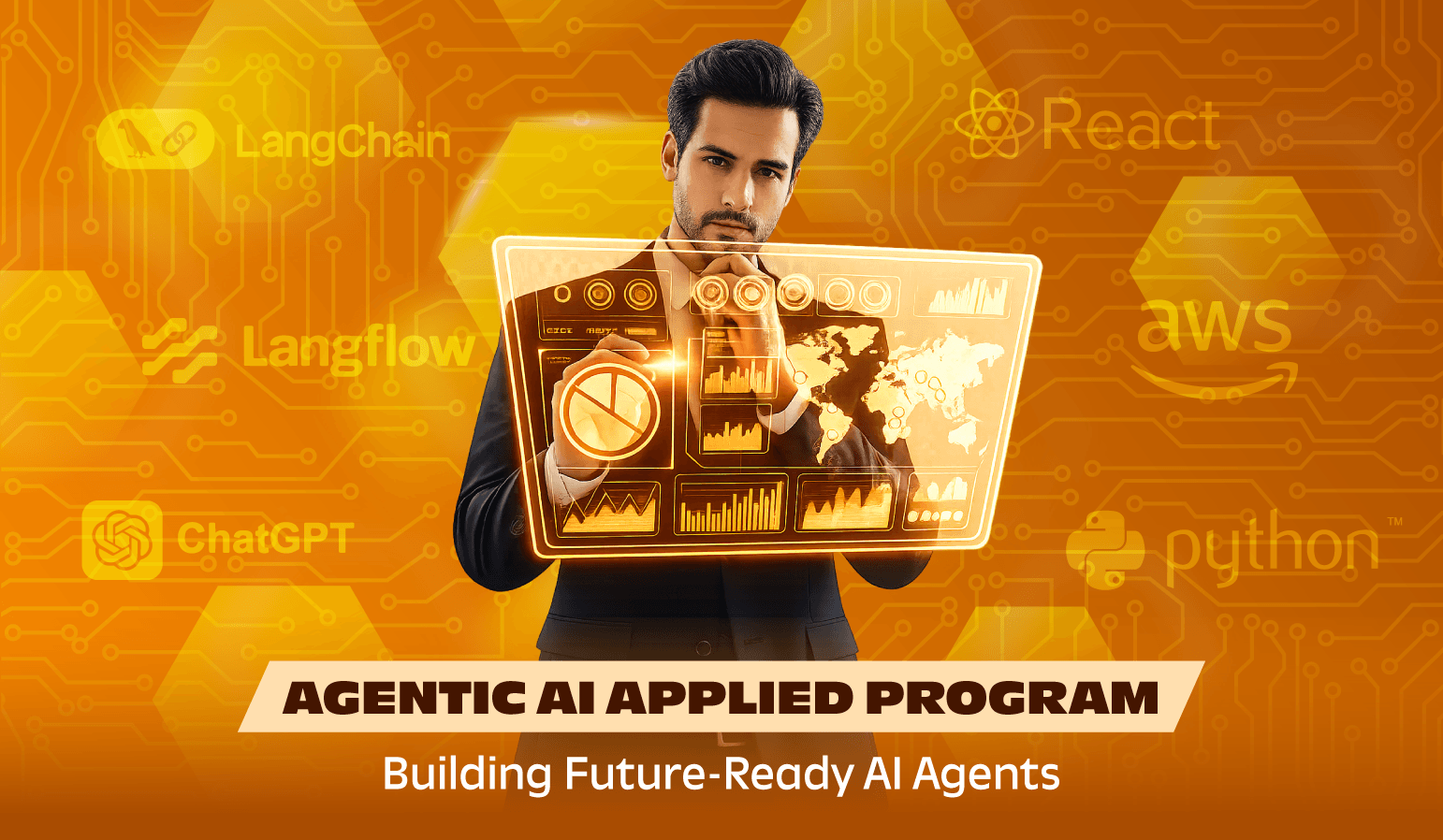
The Agentic AI Applied Program by NIIT is a sprint-based professional program designed to build job-ready skills in Agentic AI, RAG, and AI-native application development. Learners develop conversational AI agents, production-grade Retrieval-Augmented Generation (RAG) systems, and multi-agent workflows using industry-standard tools such as LangChain, LangGraph, and CrewAI. The program combines full stack engineering with AI-native architecture thinking through hands-on projects, real-world scenarios, and a capstone project, while emphasizing reliability, observability, safety, and scalable AI system design.
Curriculum
Comprehensive curriculum to build in-demand tech skills and real-world expertise.
Build AI Chat Applications and Agentic Workflows
Learn to develop conversational AI applications starting with no-code chatbot creation and progressing to advanced agentic workflows using LangChain and FastAPI.
Design Prompt-Driven Intelligent Agents
Build AI agents with structured prompting, tool calling, short-term memory, and multi-step LCEL chains for context-aware interactions.
Develop Interactive AI Frontends
Create responsive AI chat interfaces using Streamlit and React with authentication, session handling, and user authorization features.
Monitor and Optimize AI Systems
Implement observability with LangFuse to monitor traces, evaluate latency and token usage.
Build an AI agent system that integrates LLMs, tools, memory, and APIs into a reliable and observable application. Gain hands-on experience with LangFlow, LangChain, FastAPI, Pydantic, LCEL, LangFuse, Streamlit, React.
Build Knowledge-Backed RAG Applications
Learn to design and develop reliable Retrieval-Augmented Generation (RAG) systems that deliver accurate, grounded, and context-aware responses using enterprise knowledge sources.
Develop End-to-End RAG Pipelines
Build ingestion and retrieval pipelines with LangChain, implement chunking strategies, embeddings, semantic search, and vector database integration for efficient knowledge retrieval.
Implement Advanced and Multimodal Retrieval
Work with LlamaIndex and LlamaParse to process complex documents, multimodal content, tables, and images while enabling hybrid search and reranking techniques.
Integrate Structured Data and External Systems
Create SQL-powered RAG workflows, connect external systems using MCP architecture, and build agentic workflows combining structured and unstructured data retrieval.
Ensure Reliability, Security, and Observability
Implement guardrails, PII protection, citation generation, human handoff workflows, and evaluate RAG systems against quality, latency, and reliability goals.
Build a modular RAG-based intelligence system that retrieves, understands, and generates context-aware answers from complex domain-specific documents. Gain hands-on experience with LangChain, LlamaIndex, LlamaParse, PostgreSQL, pgvector, Guardrails AI.
Build Stateful and Autonomous AI Agents
Learn to design intelligent AI agents using LangGraph that can plan, reason, act, and self-check through structured agent workflows and state machines.
Develop Multi-Agent Workflows with CrewAI
Create collaborative multi-agent systems with CrewAI using role-based agents, hierarchical crews, and orchestrated workflows for complex task execution.
Implement ReAct and Self-Corrective Agents
Build advanced agentic workflows with ReAct patterns, Plan-Act-Check loops, Reflection techniques, and self-correcting behaviors for reliable decision-making.
Optimize, Monitor, and Scale Agentic Systems
Implement observability, tracing, and evaluation frameworks while optimizing agentic systems for latency, quality, resilience, and cost efficiency.
Build an autonomous multi-agent system that collaborates, reasons, and executes complex tasks through structured workflows and intelligent delegation. Gain hands-on experience with LangGraph, CrewAI, ReAct, Reflection, Multi-Agent Workflows.
Build an End-to-End Agentic AI Solution
Design and develop a production-ready Agentic AI application by combining conversational AI, RAG pipelines, tool integration, and multi-agent workflows into a unified system.
Define AI System Goals and Architecture
Identify real-world use cases, risks, and Service Level Objectives (SLOs), then design scalable AI system architectures and execution plans.
Implement Intelligent Agentic Workflows
Build core agentic flows with LangGraph and CrewAI, integrate MCP-enabled tools, and expand workflows with reasoning-driven multi-agent collaboration.
Enable Observability, Evaluation, and Reliability
Create golden evaluation datasets, implement observability and tracing, apply guardrails, and optimize the system for quality, latency, and reliability targets.
Showcase a Production-Ready AI System
Deliver a live demo with logs, evaluation reports, documentation, and a fully integrated AI solution using modern agentic AI frameworks and tools.
Gain hands-on experience across all of the above and the chosen channel or cloud environment. Each capstone is defined with explicit SLOs (success rate, latency, cost, privacy).
Tools & Technologies
Explore industry-relevant tools through hands-on learning to master practical, in-demand skills.
Projects You'll Build
Build production-ready projects to showcase real-world skills and strengthen your portfolio.
Team Coding Standards Q&A Agent
An agent built on a no-code platform that answers programmers' questions on coding standards and guidelines for a software development team.
Trip Planner Agent
An intelligent assistant that designs personalized travel itineraries based on user preferences, optimizing routes, budgets, and experiences through AI-driven recommendations.
Personalized Job Placement Agent
A conversational agent that collects user details or a pasted resume, fetches live job descriptions, and suggests targeted resume improvements and personalized cover letters.
Smart Auto Advisor Assistant
A conversational agent for car dealerships that retrieves car model, features, pricing, and availability from a company database using RAG, and provides context-aware answers to customers.
Financial Advisor Agent
A conversational agent that gathers users' financial goals, risk preferences, and investment horizons, retrieves information from financial guides and market data using RAG, and delivers personalized recommendations.
Multi-Modal RAG System for Internal FAQs
A RAG system that integrates text and image data to answer internal FAQs accurately, enabling AI-powered knowledge discovery within organizations.
Customer Ticket Resolution Assistant
An AI agent that retrieves solutions from internal ticket histories, product guides, escalation procedures, and customer interaction logs using RAG, improving support response times while maintaining data privacy.
Multi-Agent Retail Policy Intelligence System
A crew of agents that interpret policies, validate decisions against business rules, and deliver consistent, explainable outcomes. Each capstone includes defined SLOs, a live demo, evaluation report, and production runbook.
Enterprise Software Support & Resolution Intelligence System
A hierarchical workflow of agents that diagnose issues using documentation and historical data, with intelligent escalation of unresolved or high-risk cases to human experts. Each capstone includes defined SLOs, a live demo, evaluation report, and production runbook.
Financial Risk & Investment Decision Intelligence System
A coordinated set of agents that analyze market signals, assess portfolio risks, and generate validated, risk-aware investment recommendations. Each capstone includes defined SLOs, a live demo, evaluation report, and production runbook.
Boost Your Career Visibility
Showcasing a professional Capstone Project on your LinkedIn increases recruiter interest significantly. Build production-ready work that speaks for itself.
Learning Outcomes
Develop industry-relevant skills to create real-world solutions and advance your career.
Build conversational AI agents across customer-facing use cases, integrating LLM APIs safely with structured outputs, tool calling, prompt management, and short-term memory.
Design and build production-grade RAG systems: ingest, chunk, embed, hybrid search (BM25 + vector), rerank, cite sources, apply PII guardrails, integrate external systems via MCP, and evaluate against SLOs.
Design and orchestrate autonomous multi-agent systems using LangGraph and CrewAI that plan, act, self-correct, and collaborate across stateful, multi-step workflows.
Implement agentic patterns - ReAct, Plan-Act-Check, Reflection, and Self-Corrective agents - as production engineering constructs, not just research concepts.
Instrument agentic systems with observability (Langfuse tracing), safety controls (guardrails, RBAC, cost caps).
Build and present a portfolio of Agentic AI projects - including a compliance agent team, financial analyst agent, and autonomous customer support workflow - demonstrating job-ready engineering competency.
Industry-Recognized Certification
Certificate of Completion
This is to certify that
Has successfully completed the Agentic AI Applied Program
Signature
Date
Earn a trusted NIIT professional certificate.
Global Recognition
Accepted by leading employers and organizations worldwide.
Easy Sharing
Add your certificate to LinkedIn, resumes, and professional portfolios.
Career Value
Demonstrates practical skills aligned with industry needs.
Data-Driven Learning, Delivered with Quality
Experience a data-driven learning ecosystem with measurable progress.
Structured Learning Roadmap
Clear learning pathways delivered through our LMS with defined milestones and module progression.
Learner Connect Sessions
Regular live mentor interactions to resolve doubts, reinforce concepts, and maintain engagement.
AI Assisted Faculty Quality Monitoring
AI-assisted faculty performance analysis ensures consistent teaching quality and delivery excellence.
Program Performance Report
Track attendance, assignments, assessments, quizzes, and overall performance with structured progress tracking.
Meet Your Mentors
Learn from Industry Experts and Experienced Professionals.

Dr. Ayan Chatterjee
Chief Technology Officer
Dr. Ayan Chatterjee is the Chief Technology Officer at InsAnalytics, bringing over 8 years of research and development experience across Artificial Intelligence, Machine Learning, Mathematical Modeling, Medical Image Processing, and AI-driven Drug Discovery. A Gold Medalist in B.E, and a PhD in Computer Science from Northeastern University, Boston he combines academic excellence with global research credentials. His professional contributions include GPU architecture design at NVIDIA, with deployments in autonomous vehicle systems at Tesla. He has also led the end-to-end development of AI-powered medical imaging solutions for brain tumor diagnostics using MRI scans and built scalable AI platforms supporting drug discovery and gene therapy initiatives at AstraZeneca. With a strong foundation in both research and applied AI, Dr. Chatterjee brings deep technical insight and industry relevance to train the learners of Building Agentic AI Systems at NIIT.

Amrita Saha
Senior Data Scientist
Ms. Amrita Saha is a seasoned Senior Data Scientist with over 15 years of combined industry and R&D experience across AI/GenAI, Machine Learning, Big Data Analytics, and advanced Statistical and Econometrics Modeling. Her expertise spans diverse domains with hands-on proficiency in Robotics Process Automation (RPA), core economic research, and Business Intelligence with a strong focus on data visualization and dashboarding. She holds an M.Sc. in Economics, an M. Tech in Data Science & Engineering, and is a PhD Scholar in AI & Energy Economics at the Department of Finance & Economics, BITS Pilani. She plays a pivotal role in guiding learners in NIIT’s Building Agentic AI Systems program, enabling them to develop practical, industry-ready expertise in next-generation AI systems.
Frequently Asked Questions
Find answers to your queries about the program, curriculum, and admissions.
This program is designed for working professionals - software developers, full-stack engineers, and backend engineers who are already employed and want to add AI Engineering to their toolkit to access higher-value roles and higher compensation. The ideal candidate has 1+ years of professional experience writing code in Python; is comfortable with REST APIs, JSON, and client-server architecture; and has shipped at least one web application. You do not need prior machine learning or AI experience - working knowledge of what an LLM is and basic prompting familiarity is sufficient. If you write code for a living today, you are the right fit.
Admission to the program is direct. Eligible learners can apply by filling out the online application form, submitting the self-declaration and accepting the terms and conditions, and paying the program fee. Admission is confirmed once the payment is successfully completed.
You need working knowledge of GenAI concepts, prompting techniques, and common terminologies - but not formal machine learning or data science training. If you understand what an LLM is, how prompting works, and have built Python-based web applications, you have the foundation this program builds on.
NIIT follows a Mastery Learning Methodology — an immersive, sprint-based approach designed to build job-ready skills through hands-on practice and real-world problem-solving. The program is structured into learning sprints, where each sprint focuses on mastering a specific task aligned to industry job roles. Learners progress step-by-step through concept sessions, quizzes, practice assignments, reviews, feedback, and refinements. Each sprint requires approximately 4 hours of learning effort, with nearly 70% focused on hands-on implementation, practice, and refactoring. This structured methodology helps learners build confidence, gain practical experience, and apply skills effectively in real workplace scenarios.
AI Engineering is one of the fastest-growing and highest-demand skill areas for software professionals today. This program helps developers and engineers upgrade their existing programming and full stack skills with Agentic AI, RAG pipelines, LLM integration, and multi-agent orchestration capabilities that enterprises now require for production-scale AI systems. With hands-on projects, industry-relevant workflows, and production-focused learning, learners become job-ready for modern AI engineering roles where demand, hiring velocity, and compensation continue to grow significantly.
Generic AI courses are built for beginners and cover one tool or one concept at a time. This program is built for engineers - it assumes you already know how to code and jumps straight into production-grade concerns: RAG pipeline design, agentic patterns (ReAct, Plan-Act-Check, Reflection) as working implementations, multi-agent orchestration with LangGraph and CrewAI, and operational concerns (observability, guardrails, cost control) across 180 hours of structured, mentor-led, mastery-assessed learning. The capstone must meet defined SLOs with a live demo, not just function on a slide. If you are an experienced software professional, this is the program that will actually move your compensation and your role - not just add a certificate.
The capstone is an end-to-end agentic AI system designed to solve a real-world problem. It includes system design, implementation, evaluation against SLOs, and a live demonstration, along with supporting documentation such as a runbook.
The program maps directly to roles actively hiring in the agentic AI space: Agentic AI Developer, LLM Application Developer, RAG Systems Engineer, AI Orchestration Engineer, and AI Engineering Lead. These roles represent a step-change from traditional software development - both in scope and in compensation, typically 30–50% above equivalent senior software engineering positions. For working professionals already in software roles, this program provides the specific, demonstrable skill upgrade needed to transition laterally into these higher-demand, higher-compensation positions without leaving the engineering career track.
Learners complete course-embedded project builds - including a financial advisor agent, customer ticket resolution assistant, multi-modal RAG system, and job placement agent - plus a fully instrumented capstone project with a live demo, evaluation report against SLOs, and a production runbook. These are directly presentable to employers.
Learners need a laptop or desktop with Intel i3 or AMD Ryzen 3 (or higher), at least 8 GB RAM, and 50 GB free disk space, along with a functional webcam and microphone. The system should run Windows 10 or macOS (or higher) with the latest Chrome or Edge browser, MS Office or equivalent tools, and a PDF reader installed. A stable Wi-Fi or broadband connection with a minimum speed of 5 Mbps is required, and a backup internet connection is recommended.
All frameworks and infrastructure used- LangChain, LlamaIndex, LangGraph, CrewAI, Langfuse, Guardrails AI, and Postgres+pgvector - are open-source and free. No paid software subscriptions are required at any stage of the program.
No, prior experience with the specific frameworks is not required. The program teaches how to use these tools from a practical, implementation-first perspective. However, strong programming fundamentals and familiarity with APIs are expected.
Taking a loan is entirely optional. Loans are facilitated by third-party lenders, and NIIT has no role in the process. Applicants must review the loan terms carefully, including EMIs, interest rates, processing fees, and repayment schedules. All EMI payments and related queries must be handled directly with the lender.
Documents may include PAN Card and Aadhaar Card, last 6 months’ bank statements, 3 months’ salary slips (for employed learners) or ITR proof (for self-employed), and co-applicant details if the learner is under 21 years of age. Incomplete documentation may result in loan rejection.
Yes, learners receive a digital certificate after successfully completing the program and meeting all the required conditions (overall performance score, attendance, payment clearance etc).
Hassle-Free Refund Policy
Your satisfaction is our priority. We offer transparent refund terms for your peace of mind.
100% Money-Back Guarantee
Full refund (excluding the booking fee) if you cancel before the batch starts
Quick Refund Review
Eligible refund requests are carefully reviewed within seven working days
Transparent Refund Timeline
Approved refunds are completed within 45 days for timely settlement
Important: Enjoy a transparent refund policy. Cancel 48 hours before the class start date to be eligible for a refund if you haven’t attended any class.
Tell us your preferred slot
Custom Schedule Assistance
Investment Plan
Secure your future today
Exclusive of 18% GST
Secure your seat with a token booking fee of ₹1,500 today.
Exclusive of 18% GST