
From Course Catalog to Learning Architecture: How Leading Enterprises Are Redesigning Their Learning Content Strategy
Here is a question worth sitting for a moment: when did anyone in your organization last look at the full learning catalog and ask whether it was serving the business requirements?
Not whether the content exists. Not whether courses are being completed. But whether employees are learning the skills the organization genuinely needs them to learn.
For most enterprise L&D teams, the question is hard to answer because the catalog was never designed with that purpose in mind. It just grew. A request came in, content got built, it got published, and the old material stayed because removing it was never anyone's job. Multiply that across years and vendors and shifting business priorities, and you end up with a library that is simultaneously enormous and somehow still not enough.
The Josh Bersin’s research makes the scale of this problem concrete: despite record investment in content and platforms, 74% of enterprises are not keeping up with their organization's demand for new skills. More content is not fixing that. A defined learning content strategy would.
The Catalog Model Has a Structural Flaw
There was a time when the course catalog made a lot of sense. Training was largely about compliance, induction, and role-based skills that changed slowly. A well-stocked library meant employees could find what they needed, complete it, and move on.
That assumption no holder holds. LinkedIn’s Work Change Report mentions that 70% of the skills used in most jobs today will change by 2030 with AI emerging as a catalyst. In that environment, a content development process that takes months from brief to publish is not a learning asset, it is a delay. Content ages faster than it gets reviewed. Skills requirements shift faster than vendor contracts get renegotiated.
And underneath all of this lies a structural flaw that rarely gets named: enterprise libraries accumulate because adding content is always easier than removing it. Every new request has a champion. Nobody champions deletion. So, the catalog grows, the signal-to-noise ratio drops, and the employees who need to find relevant learning give up and go to Google instead.
A course catalog tells you what learning is available. A learning architecture tells you what capability the business actually needs and whether anything in the catalog is building it.
What Enterprise Learning Architecture Governs
Learning architecture is not a technology decision. It is not about which LXP to deploy or how to configure the LMS. It is a framework that answers four questions:
- What specific capabilities does the business strategy require - by function, role, and geography?
- Which of those capabilities can be developed through structured content, and which need practice, coaching, or something embedded in the flow of work?
- What content - built, licensed, or curated - maps to each capability, and what exists in the portfolio that maps to nothing?
- Who is responsible for each content domain, how often is it reviewed, and what triggers it being retired?
Josh Bersin describes an enterprise learning architecture as one that gives employees a clear, memorable approach to learning and gives L&D the framework to use new tools without creating chaos. That framing matters even more now as AI is actively reshaping how content gets found, recommended, and consumed.
The NIIT and St. Charles Consulting Group's Learning Transformation Benchmark puts it plainly: learning can no longer function primarily as a delivery engine. AI compresses the time between learning and action, and embeds guidance directly into workflows. Whether that guidance is valuable or just more noise depends entirely on the architecture behind it. The organizations that get this right are not the ones that adopted AI earliest. They are the ones that had the architecture ready for it.

How Do Leading Enterprises Redesign Their Learning Content Strategy?
The organizations that have made this shift from accumulation to architecture see this as a permanent change in how content decisions get made. They follow these three practices:
Organize Around Capabilities, Not Topics
A topic-based portfolio groups learning by subject: leadership, compliance, data literacy, communication. A capability-mapped portfolio groups it by what specific people need to be able to do in specific business contexts. From the outside, the two can look similar. In practice, they deliver very different outcomes.
When content is mapped to a capability and a business context, gaps become visible. So does duplication. And suddenly the ROI conversation changes - it is no longer about completion rates, but about whether the capability is actually developing. That shift gives CLOs the evidence they need to defend the investment, and a clear basis for the next content decision.
Treat Content Like It Has an Expiry Date Because It Does
Most L&D functions operate on the assumption that published content stays until something replaces it. That assumption is expensive. It is also, increasingly, a trust problem.
Think about a leadership program built around a talent philosophy the organization has since moved away from. It does not just waste the renewal budget. It tells every employee who encounters it that the learning library is not worth trusting and that it exists to tick boxes, not to help them.
High-performing L&D teams design review cycles into the content operating model from the start. Every asset has a named owner, a review trigger (time-based or event-based), and a clear process for retirement. This is not an onerous operational burden if it is built in from the beginning. It becomes one if it is not. Gartner's research on L&D strategy frames this as a shift toward outcome-driven agile learning where content is continuously aligned to work and performance, rather than simply maintained by default.
Make the Build-Buy-Curate Decision Before Spending the Budget
Not every capability gap requires a new course. Some are best addressed through curated external content. Some require strategic eLearning development because the business context is too specific for anything off-the-shelf. Some are better handled through a job aid, a manager conversation, or practice built directly into the workflow.
A mature learning content strategy makes that distinction before commissioning anything. For many enterprise L&D teams, this is where managed content development partnerships deliver the most strategic value: not as a production line for an ever-growing catalog, but as the capability to audit what exists, be clear about what is worth building, and have the discipline to stop building what is not.
Real-World Impact of Building a Centralized Enterprise Learning Architecture
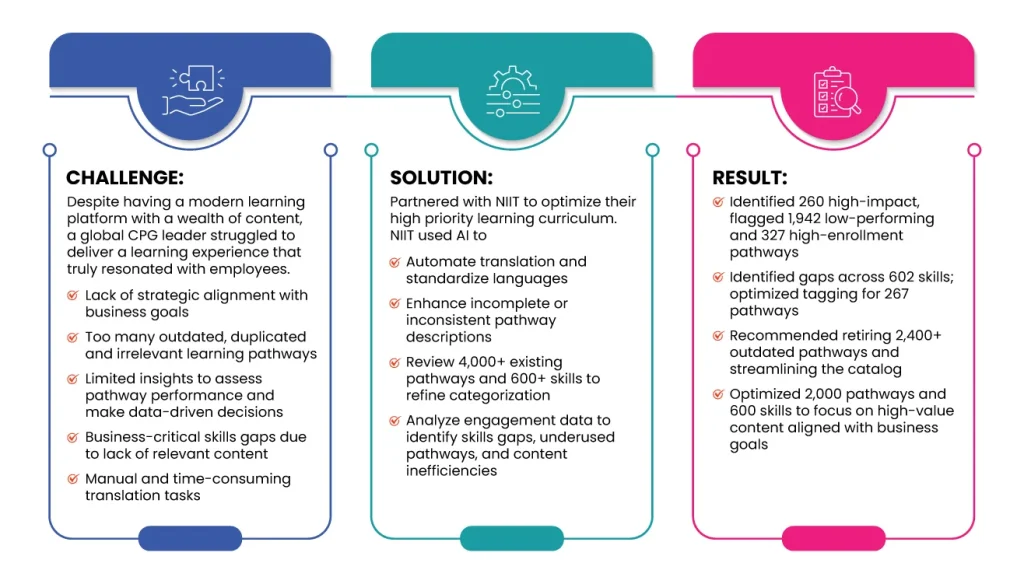
Explore how this was done – read the full story here.
From Content Spend to Strategic Investment
A content portfolio redesign at enterprise scale is not an L&D housekeeping task. It is a business decision that touches budget allocation, capability planning, and how the organization measures the return on its talent investment.
The case starts with waste: content that is unused, outdated, or unmapped to any active capability priority represents real spend with no return. It continues with speed: a capability-mapped architecture reduces time-to-competency for the roles most critical to executing strategy. And it ends with credibility - learning evidence that business leaders use, tied to outcomes rather than activity.
McKinsey's research on enterprise learning describes the direction plainly: the function is moving from a provider of training programs to an architect of developmental ecosystems. That shift does not happen through a platform decision or a content refresh. It happens when the organization treats L&D transformation as a structural investment with the same governance, measurement discipline, and accountability applied to any other enterprise capability.
Thinking About Your Content Portfolio Redesign?
NIIT partners with enterprise L&D teams to audit existing content portfolios, build capability-mapped learning architectures, and deliver learning consulting approach at the scale global organizations require. If your content estate has outgrown its original design or if you are not sure what it was originally designed to do, talk to our experts and know where to start.